How to clean stainless steel appliances without streaks
A good stainless-steel finish begins with the cleaning underneath it. Give surface dirt, handles and reachable edges proper attention before completing the appliance’s approved finishing step.

How do you clean stainless steel appliances thoroughly?
Identify the finish, remove permitted surface dirt, attend to the detail areas and complete the specified finishing step.
1. Inspect the appliance in good light
Find the model and finish-care instructions. Note where marks are concentrated: the door centre, handle area, lower edge or trim. Photograph existing scratches or damaged coating before cleaning so they do not become targets for repeated scrubbing. Let cooking appliances cool and follow their shutdown instructions.
Look closely for the grain direction where visible; it may differ between components. A handle, control panel and door front are not necessarily the same material. Choose the method for each part rather than treating the entire appliance as one sheet of metal.
2. Prepare separate cleaning and finishing cloths
Keep one cloth for the initial allowed cleaning method and a clean, dry one ready for the finish. Fold the working cloth so you can expose a fresh face as it picks up residue. Protect adjacent surfaces from the product and keep it away from food, dishes and electrical openings.
3. Remove surface dirt before adding a finishing layer
Use the appliance’s permitted gentle cleaning method. Work in small, visible sections rather than spreading product over the entire front at once. Change the dirty face of the cloth and check the result as you go. Follow the instructions for removing detergent or cleaner residue and drying the surface before the next product.
Samsung describes mild, non-abrasive cleaning where permitted, with appropriate cloth care and drying. Whirlpool also distinguishes cleaning from finishing. Use the Samsung refrigerator guide or Whirlpool stainless-steel guide alongside the instructions for your exact model.
For stubborn material, use only the softening method and contact time allowed for that finish. Avoid trying to lift it with a fingernail, blade or scouring pad. A remaining mark is a reason to identify the problem, not automatically a reason to press harder.
4. Give reachable handles and edges their own pass
Inspect the accessible handle area and the perimeter of each panel. Clean the permitted surfaces without dismantling parts or forcing a cloth into an opening. Recheck lower edges where marks can be easy to miss while standing. Keep product off a display or plastic trim unless that material’s instructions permit it.
5. Complete the approved finish
Where a finishing wipe or cleaner is allowed, follow its application and buffing directions. Use the grain direction specified for that component. Keep the finishing cloth clean so it does not put the earlier dirt back onto the panel. Do not keep adding more polish to compensate for an unfinished cleaning step.
6. Inspect the dry result from more than one angle
Look at the broad panels, around the handles and along the edges in consistent light. Check whether the apparent mark moves with the reflection or remains in one place. Confirm that no product remains on neighbouring surfaces. Record any fixed mark for the appliance maker or an appropriate specialist rather than improvising a repair.
A useful completion checklist is simple: the agreed reachable surfaces were cleaned; permitted residue removal is complete; the correct finish was applied where needed; and existing damage has been kept separate from cleaning results.
Which products should you use, and could they be harmful?
Check surface compatibility and exposure precautions separately. A cleaner that suits one finish is not automatically suitable for another material or harmless to touch.
Swipe or scroll to see all columns →
| Product or tool | Useful role | What to check |
|---|---|---|
| Clean soft microfiber cloth | Applying the permitted method and removing surface residue. | Inspect for grit and keep a fresh cloth for finishing. |
| Mild non-abrasive detergent, where permitted | Ordinary dirt on surfaces whose care guide allows it. | Follow the appliance’s instructions for dilution and removal; avoid flooding seams or controls. |
| Weiman Stainless Steel Wipes | One example of a dedicated cleaning and finishing product. | Its compatibility restrictions matter, particularly for coated or fingerprint-resistant surfaces. |
| The appliance maker’s recommended product | Care selected for the exact model and finish. | A stainless appearance does not prove uncoated steel. Check trim and displays separately. |
What do the wipe instructions actually tell you?
As an example, Weiman’s wipe guidance calls for pre-cleaning heavy buildup, wiping with the grain and buffing with a soft dry cloth. It says the wipes are not disinfectants and does not present them as scratch repair. For food-contact surfaces it specifies washing with mild detergent and water before food contact. This is a product example, not identification of the brand used by Heron.
How do you read the safety information?
Read the back label for surface exclusions, skin and eye warnings, ventilation, required protection and first-aid directions. Never mix cleaners. Keep them in original containers out of children’s and pets’ reach. Health Canada’s household chemical guidance explains these precautions.
For a supplied safety data sheet, match the product name and version to your container. Section 2 covers hazards, 4 first aid, 7 handling and storage, 8 exposure protection and 10 reactivity. CCOHS explains the SDS sections. “Suitable for this finish” does not mean harmless under every kind of exposure.
A real Heron fridge clean: detailed cleaning, then the finishing step
We thoroughly cleaned this fridge exterior first, then used stainless-steel wipes for the finishing step.
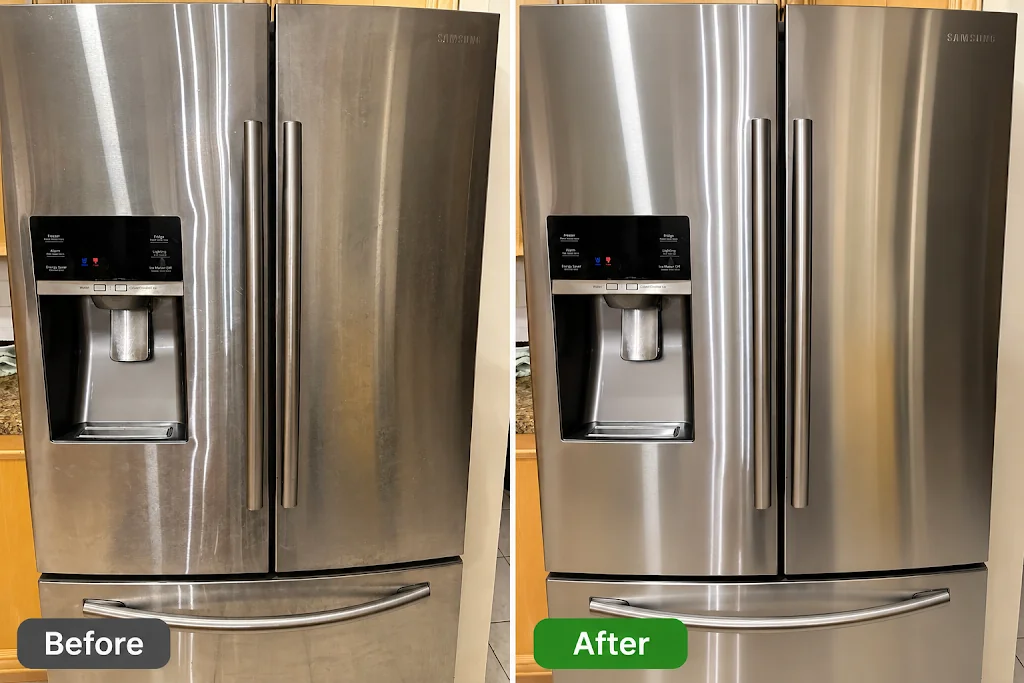
The work shown here involved cleaning the exterior in detail before finishing it. The wipes came after that cleaning. The before image shows visible marks and an uneven appearance across the doors; the after image shows a more even finish.
The result depends on the finish and the condition of the appliance. Cleaning can improve fingerprints and surface residue; scratches and worn coatings need a different assessment.
The detailed sequence above explains how to plan this work on an appliance whose care instructions permit it. It is general guidance, rather than a claim that a particular brand or every listed step was used on this photographed job.
What this example means for your own kitchen
Describe the result you want when booking: cleaner door fronts, attention around handles, or cleaning inside the appliance. Those are different jobs. Point out coating information or existing damage so the agreed work suits the appliance rather than simply aiming to reproduce a photograph.
It also helps to separate everyday upkeep from a detailed reset. A few fingerprints on the fridge door can belong on a regular kitchen list; buildup across the kitchen may call for a Deep-cleaning discussion. Neither automatically includes emptying and cleaning the fridge interior.
Why does stainless steel still look streaky after cleaning?
Check cloth cleanliness, product compatibility and the required finishing step before adding more cleaner.
Review the cleaning process before adding another product. Check whether the cloth was clean, whether the cleaner is approved for that finish and whether its finishing step was completed. Look at the surface in consistent light so you can distinguish residue from a reflection or a fixed mark.
- Marks following the wiping direction: check the label’s buffing or drying instructions and use a fresh cloth.
- A mark that stays in the same place: it may need assessment rather than more cleaning. Do not promise that a scratch or worn coating can be cleaned away.
- Smudges returning around a handle: add that high-touch area to the household’s quick maintenance list.
- An uncertain finish: stop and consult the model’s care guide before using a polish, acid or abrasive.
Our practical recommendation is to keep the appliance manual and chosen product instructions together. That makes it easier for everyone cleaning the home to use a consistent method.
Does professional kitchen cleaning include stainless steel appliances?
A selected Heron kitchen clean includes appliance exteriors; the fridge, oven and cabinet interiors are separate choices.
Heron’s selected kitchen cleaning includes appliance exteriors. Cleaning inside the fridge, oven or cabinets is separately selected. Tell us about sensitive finishes and agree the work before the visit.
For a wider home reset, use our Deep-cleaning checklist. Before moving, compare the appliance and cupboard tasks in the move-in cleaning checklist. Construction dust after building work belongs in a post-renovation scope.
Explore Deep cleaning in Mississauga, Deep cleaning in Brampton or house cleaning in Oakville. The service-area directory covers Heron’s other cities and communities.
Build my cleaning quoteCall 289-813-7484
You can email the calculator quote to yourself before calling. An emailed quote is valid for seven days and does not reserve an appointment.
Stainless steel cleaning questions
Did Heron only use stainless-steel wipes on the pictured fridge?
No. We thoroughly cleaned the fridge exterior first, then used stainless-steel wipes for the finishing step. The before-and-after comparison shows that exterior result.
Are stainless-steel wipes disinfectants?
Do not assume so. The Weiman wipes cited as an example are not disinfectants. A polished appearance is not evidence that a surface has been disinfected.
Are stainless-steel cleaners harmful?
Read the exact product label and matching safety sheet. Check exposure warnings, ventilation, protective equipment and food-contact restrictions separately from compatibility with the appliance finish.
Can I use stainless-steel wipes on every appliance?
No. Check both the exact appliance’s care instructions and the wipe label. A coated or fingerprint-resistant surface may need different care, and a stainless-steel cleaner may not suit a display, plastic trim or another metal.
Should I wipe with or against the grain?
Where the manufacturer permits a stainless-steel cleaner, follow its directions. The Samsung and Weiman guidance cited here calls for wiping along the grain.
Will stainless-steel wipes remove scratches?
Do not treat a cleaner or polish as scratch repair. If a fixed mark remains, identify whether it is residue, damage or a coating problem before trying another method.
Did Heron clean the inside of the fridge shown here?
The photographs demonstrate the exterior result only. They do not document interior work. Fridge-interior cleaning is a separate selection when you book with Heron.
Do I need a separate cloth for buffing?
Follow your product’s instructions. The wipe directions linked above call for a soft, dry cloth after wiping. Keep a fresh cloth for that finishing step so you do not put surface dirt or excess product back onto the appliance.
Which care guide should you read next?
Use the method for the actual material or appliance you are cleaning.
Where can I book help with these cleaning tasks?
Find cleaning help for the tasks covered here. For preparation and booking details, see Kirkendall cleaning in Hamilton or Castlemore cleaning in Brampton. Each guide explains local access planning and how to choose the requested rooms and extras.
Sources
Manufacturer guidance checked October 19, 2026. Always use the instructions for your exact appliance and cleaner. The fridge before-and-after shows Heron’s own cleaning work.
Heron’s rate card 2026-11-11 defines the selected cleaning scope.